
You’ve found a job that matches your experience. You’ve updated your CV, clicked “Apply,” and waited for a response.
A week passes. Then another.
Nothing.
Most job seekers assume a recruiter looked at their resume and decided they weren’t a good fit. In many cases, that’s not what happened at all. The reality is that a human may never have seen the application.
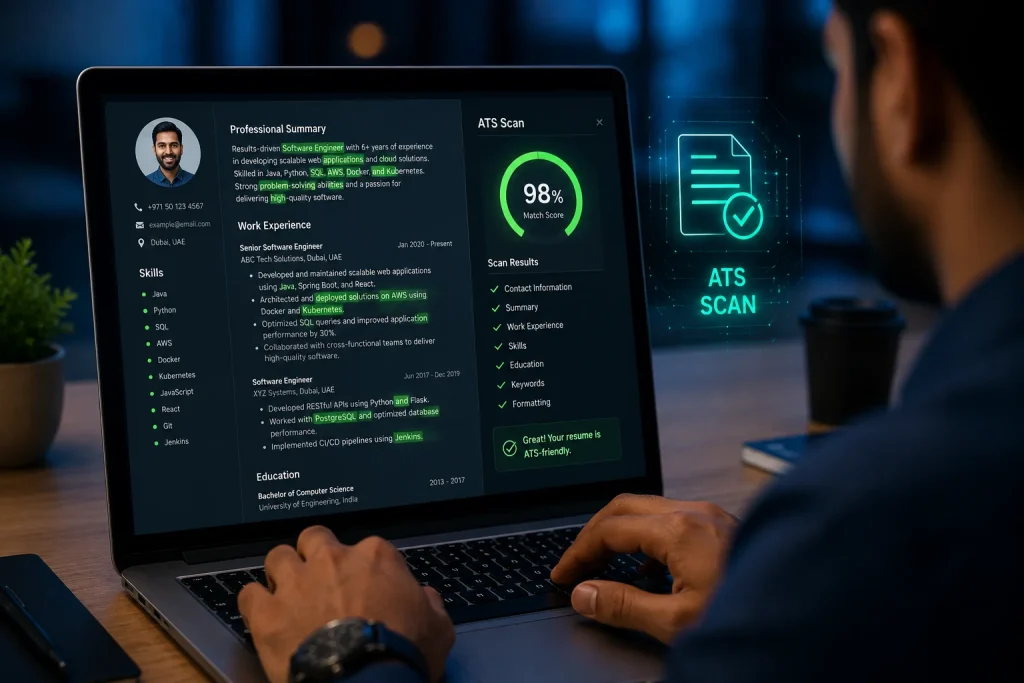
Before a recruiter reviews a CV, it often goes through an Applicant Tracking System, better known as an ATS. These systems help employers manage large volumes of applications and identify candidates who appear to match the requirements of a role.
This means your resume has two jobs. First, it must be readable and relevant to the ATS. Second, it must convince a recruiter that you’re worth interviewing.
The good news is that creating an ATS-friendly CV doesn’t require expensive software or professional writing services. Once you understand how these systems work, you can make simple improvements that dramatically increase your chances of getting noticed.
Whether you’re applying for jobs in the UAE, Saudi Arabia, Qatar, Oman, or anywhere else in the world, understanding ATS optimization can give you a real advantage.
What Is an ATS and Why Should Job Seekers Care?
Let’s start with the basics.
An Applicant Tracking System is software that employers use to collect, organize, and filter job applications.
Think of it as a digital filing cabinet combined with a search engine.
When a company receives hundreds of applications for a single vacancy, manually reviewing every CV would take a huge amount of time. ATS software helps recruiters narrow down the list by identifying candidates who appear to match the position.
How ATS Software Works
Imagine a company is hiring a Customer Service Executive.
The job description might mention:
- Customer service
- CRM software
- Complaint handling
- Communication skills
- Sales support
When candidates apply, the ATS scans each resume looking for those terms and related skills.
If your CV contains relevant information, you have a better chance of moving forward.
If important details are missing, your application may never reach the recruiter’s desk.
That’s why ATS optimization matters.
Why Qualified Candidates Still Get Rejected
Many people assume ATS systems reject candidates because they lack experience.
Sometimes that’s true.
But often, candidates are overlooked for completely different reasons.
Common issues include:
- Missing keywords
- Poor formatting
- Unclear job titles
- Graphics that confuse the system
- Generic resumes sent to every employer
A candidate can be perfectly qualified and still fail to appear in recruiter searches simply because their CV isn’t structured properly.
What an ATS-Friendly CV Actually Looks Like
One of the biggest myths about resume writing is that your CV needs to look creative.
In reality, ATS systems prefer simplicity.
The easier your resume is to read, the better.
Essential Sections Every Resume Should Have
Most ATS software expects to see familiar headings.
These usually include:
- Contact Information
- Professional Summary
- Work Experience
- Skills
- Education
- Certifications
- Languages
Using standard headings makes it easier for the software to understand where information belongs.
Keep the Layout Simple
Many job seekers spend hours designing visually impressive resumes.
Unfortunately, ATS systems don’t care how attractive your CV looks.
They care about readability.
A simple layout with clear headings often performs much better than a heavily designed document.
Think clean rather than clever.
Use Easy-to-Read Fonts
Some fonts look stylish but create unnecessary complications.
Stick with familiar options such as:
- Arial
- Calibri
- Helvetica
- Times New Roman
Use consistent formatting throughout the document.
A recruiter should be able to scan your CV quickly without feeling overwhelmed.
Understanding Resume Keywords
Keywords are probably the most important part of ATS optimization.
Yet they’re often misunderstood.
What Are Resume Keywords?
Keywords are simply words and phrases related to the job you’re applying for.
They can include:
- Technical skills
- Certifications
- Software programs
- Job titles
- Industry terminology
For example, an accountant’s keywords might include:
- Financial Reporting
- Accounts Payable
- Budgeting
- SAP
- IFRS
A healthcare professional may use:
- Patient Care
- DHA License
- Electronic Medical Records
- Clinical Assessment
Different industries have different keyword priorities.
Where to Find the Right Keywords
You don’t need special software to find keywords.
Most of the time, they’re already sitting in front of you.
Look carefully at the job description.
Pay attention to:
- Required skills
- Preferred qualifications
- Software requirements
- Certifications
- Responsibilities
When employers repeat certain terms, that’s usually a clue that they’re important.
Where Keywords Should Appear
Keywords should appear naturally throughout your CV.
Good places include:
- Professional Summary
- Skills Section
- Work Experience
- Certifications
- Achievements
The goal isn’t to stuff your resume with keywords.
The goal is to accurately describe your experience using language employers recognize.
Optimizing Every Section of Your CV
A strong ATS-friendly resume isn’t just about keywords. Every section should support your application.
Write a Professional Summary That Gets Attention
Your summary is one of the first things recruiters see.
Instead of writing something vague like:
“Hardworking individual seeking opportunities.”
Try something more specific:
“Customer Service Professional with five years of experience supporting clients in retail and hospitality environments. Skilled in customer relationship management, conflict resolution, and team collaboration.”
Notice the difference.
The second example immediately tells both the ATS and the recruiter what the candidate offers.
Improve Your Work Experience Section
Many people describe their duties.
Fewer people describe their impact.
Compare these two examples:
Basic Version
“Answered customer calls.”
Stronger Version
“Handled more than 70 customer inquiries daily while maintaining a customer satisfaction rating above 95%.”
The second example provides context and measurable results.
Recruiters love numbers because they help demonstrate real value.
Build a Strong Skills Section
A skills section should be easy to read.
Consider grouping skills into categories.
For example:
Technical Skills
- Microsoft Excel
- Power BI
- SAP
- Salesforce
Professional Skills
- Team Leadership
- Customer Service
- Project Coordination
- Problem Solving
This structure helps both ATS systems and recruiters scan information quickly.
Don’t Forget Certifications
Certifications often contain valuable keywords.
Examples include:
- PMP
- DHA Eligibility
- OSHA Certification
- Google Analytics
- Cisco Certifications
- CIPD
If a certification is relevant to the role, make sure it’s clearly visible.
Common ATS Mistakes That Cost Candidates Interviews
You don’t have to make dramatic mistakes to hurt your chances.
Sometimes small issues create big problems.
Using Too Many Graphics
Skill bars, charts, icons, and infographics may look impressive.
The problem is that some ATS systems struggle to read them.
What looks professional to you may appear as empty space to the software.
Simple text almost always works better.
Sending the Same Resume Everywhere
This is one of the most common mistakes job seekers make.
A sales role requires different keywords than a customer service position.
A project management role requires different keywords than an administrative position.
Customizing your resume takes extra time, but it often leads to better results.
Keyword Stuffing
Some candidates try to outsmart ATS software by repeating keywords excessively.
That approach rarely works.
Recruiters can spot unnatural writing immediately.
Instead, focus on using keywords where they genuinely fit.
ATS Optimization for GCC Jobs
If you’re applying for jobs in the Gulf region, there are a few additional considerations.
What Employers in the GCC Often Look For
Recruiters in the UAE, Saudi Arabia, Qatar, Bahrain, Kuwait, and Oman frequently pay attention to:
- Relevant industry experience
- Professional licenses
- Language skills
- Current location
- Visa status
- Availability to join
These details can help recruiters evaluate candidates more efficiently.
Important GCC Keywords
Different sectors use different terminology.
For healthcare:
- DHA
- MOH
- HAAD
- Patient Care
For engineering:
- AutoCAD
- Primavera
- Saudi Council of Engineers
For hospitality:
- Front Office Operations
- Guest Relations
- Hotel Management Systems
Using industry-specific language helps your CV align with employer expectations.
Resume Tools That Can Help
There are many tools available today that can help identify weaknesses in your resume.
Resume Scanners
Resume scanners compare your CV against a job description.
They often highlight:
- Missing keywords
- Formatting issues
- Areas for improvement
They’re not perfect, but they can provide useful insights.
AI Resume Tools
AI tools can assist with:
- Writing summaries
- Improving wording
- Suggesting keywords
- Refining formatting
Just remember that AI should support your experience, not replace it.
Always review the final document carefully.
Professional Resume Reviews
Sometimes an outside perspective is valuable.
A professional reviewer may identify problems you’ve overlooked after reading your CV dozens of times.
How to Customize Your Resume for Every Application
Customization remains one of the most effective ways to improve your success rate.
Read the Job Description Carefully
Before making changes, understand what the employer wants.
Look for:
- Required qualifications
- Key responsibilities
- Technical skills
- Preferred experience
These details should guide your updates.
Match Your Experience to the Role
You don’t need to rewrite your entire career history.
Instead, emphasize the experiences most relevant to the position.
Recruiters want to see a clear connection between your background and their vacancy.
Adjust Keywords Naturally
Sometimes a few small changes make a big difference.
Updating your summary, skills section, and work experience with relevant terminology can improve ATS performance significantly.
Frequently Asked Questions
Do ATS Systems Really Reject Resumes Automatically?
Many ATS systems filter applications based on employer requirements. If your resume doesn’t contain relevant information, it may not appear near the top of recruiter searches.
Is PDF Better Than Word?
Follow the employer’s instructions whenever possible. Both formats are commonly accepted, although some systems perform better with Word documents.
Can ATS Read Graphics?
Not always. That’s why simple formatting remains the safest choice.
Do GCC Employers Use ATS?
Absolutely.
Large employers, hospitals, airlines, banks, hotels, and multinational companies across the GCC frequently use ATS software during recruitment.
Final ATS Resume Checklist
Before applying for any position, ask yourself:
Formatting
✓ Is the layout simple and clean?
✓ Are section headings clear?
✓ Is the font easy to read?
✓ Have I avoided unnecessary graphics?
Content
✓ Does my CV contain relevant keywords?
✓ Are my achievements measurable?
✓ Is my experience clearly explained?
✓ Are certifications included?
Submission
✓ Have I customized the resume for this role?
✓ Have I checked for spelling errors?
✓ Are my contact details correct?
✓ Am I using the requested file format?
Final Thoughts
An ATS-friendly CV isn’t about beating a system. It’s about communicating your qualifications clearly.
Employers use ATS software because they receive large numbers of applications. The system helps them find candidates who appear relevant. Your job is to make sure your experience is easy to find and easy to understand.
The best resumes are usually not the most colorful or creative. They’re the ones that clearly show what you’ve done, what skills you have, and how those skills match the job.
If you’ve been applying for jobs without receiving many responses, don’t immediately assume you’re unqualified. Sometimes the issue isn’t your experience at all. Sometimes it’s simply the way your CV is structured.
A few thoughtful adjustments can make the difference between being overlooked and being invited to an interview.