
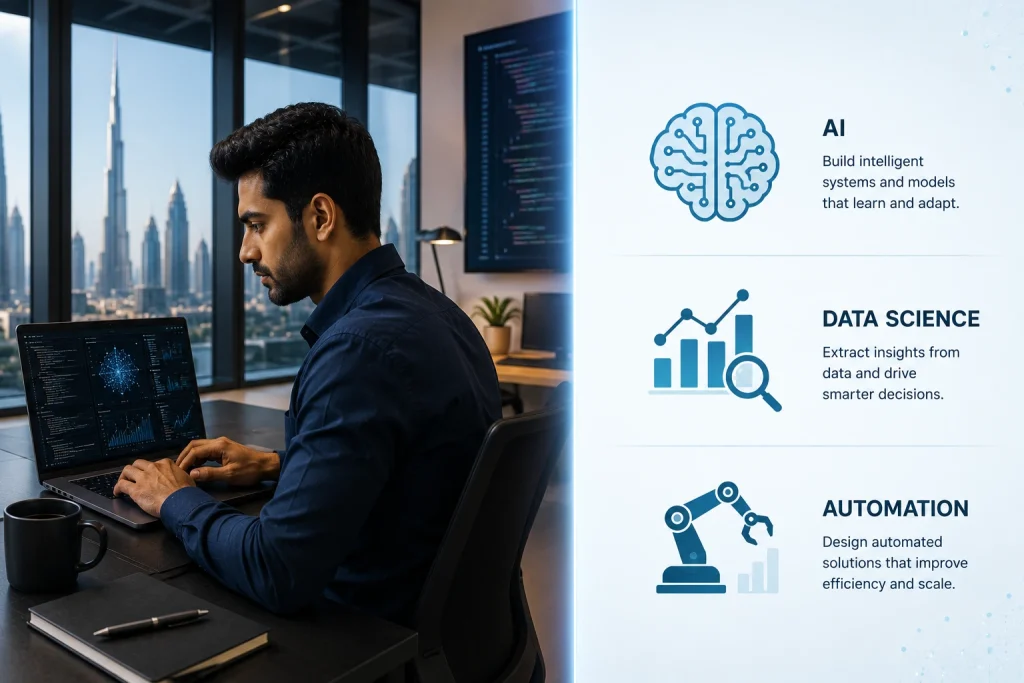
A few years ago, artificial intelligence felt like something reserved for tech giants, research labs, or futuristic conversations.
Today, it’s becoming part of everyday business.
Companies are using AI to improve customer experiences, automate repetitive tasks, make faster decisions, analyze large amounts of data, and create new products and services. What once felt specialized is now becoming more visible across industries.
Across the GCC region, this shift is creating new career opportunities.
Businesses are investing in technology more aggressively, digital transformation initiatives continue expanding, and organizations are looking for professionals who can understand, implement, and work alongside AI.
That does not mean every AI job requires advanced mathematics or years of research experience.
In reality, AI careers are becoming more diverse.
Some roles focus heavily on engineering and technical development.
Others combine business thinking, communication, problem solving, and technology.
Whether you are a student exploring future opportunities, an experienced professional considering a career transition, or someone curious about where the market is heading, understanding AI jobs in GCC can help you prepare more confidently.
This guide explains what AI careers actually involve, where opportunities are growing, which skills matter, and how you can start moving toward this fast-changing field.
What Are AI Jobs?
Artificial intelligence jobs are roles that involve creating, improving, managing, or applying systems that help machines process information, recognize patterns, support decisions, or automate tasks.
That sounds technical and sometimes it is but AI work exists across many business functions.
AI professionals may help organizations:
- Analyze data
- Improve business decisions
- Automate workflows
- Build intelligent products
- Personalize customer experiences
- Increase operational efficiency
The important thing to understand is this:
AI is not one single career.
It is an entire category of opportunities.
That’s why people with different backgrounds are entering the field.
AI Careers Are More Diverse Than People Think
When people hear “AI job,” they often imagine someone writing complex code all day.
That’s only part of the picture.
AI-related careers now include technical and non-technical paths.
Examples include:
- AI Engineer
- Machine Learning Engineer
- Data Scientist
- AI Product Manager
- Data Analyst
- AI Consultant
- Automation Specialist
- AI Operations Roles
Some positions require deep technical expertise.
Others focus more on strategy, business outcomes, communication, and implementation.
That flexibility is one reason AI careers continue attracting interest.
Why AI Jobs Are Growing Across GCC
The GCC region is experiencing rapid digital growth.
Organizations are modernizing systems, improving efficiency, and investing in innovation.
As these changes continue, demand for technology talent is increasing.
But this growth is not happening because companies want technology for its own sake.
They want better outcomes.
Businesses are using AI to:
- Improve productivity
- Reduce repetitive work
- Make faster decisions
- Understand customer behavior
- Support business growth
That creates opportunities for professionals who understand both technology and business needs.
Digital Transformation Is Expanding Career Opportunities
Technology is becoming part of everyday operations.
Industries across the GCC continue adopting digital solutions.
Examples include:
- Smart services
- Automation
- Data-driven decisions
- Predictive systems
- Intelligent customer experiences
As adoption grows, so does hiring demand.
Businesses Are Investing for the Long Term
AI is increasingly viewed as part of long-term growth strategies.
Companies are building internal capabilities rather than treating AI as a short-term trend.
That means opportunities continue appearing across experience levels.
Employers are often looking for people who demonstrate:
- Curiosity
- Adaptability
- Learning ability
- Practical thinking
Experience matters—but growth mindset matters too.
Popular AI Jobs in GCC
AI careers look different depending on industry and business goals.
Understanding the options makes the field feel more approachable.
AI Engineer
AI engineers help build and implement intelligent systems.
Typical responsibilities may include:
- Developing solutions
- Improving model performance
- Supporting deployment
- Integrating systems
This role combines technical problem-solving with practical implementation.
Machine Learning Engineer
Machine learning professionals create systems that improve through data.
Responsibilities often include:
- Building models
- Testing outcomes
- Improving accuracy
- Supporting automation
This remains one of the most discussed AI career paths.
Data Scientist
Data scientists transform information into useful insights.
They often help organizations answer questions such as:
What is happening?
Why is it happening?
What may happen next?
Responsibilities may include:
- Analysis
- Forecasting
- Reporting
- Business recommendations
Data continues to influence decision-making.
AI Product Manager
Not every AI role involves coding.
AI product managers connect business goals with technology execution.
Their responsibilities often include:
- Defining priorities
- Coordinating teams
- Managing solutions
- Improving user experiences
This role suits people who enjoy both technology and strategy.
Emerging Innovation Roles
New opportunities continue appearing.
Examples include:
- AI operations
- AI consulting
- Intelligent automation
- Innovation programs
Career options continue expanding.
Industries Hiring AI Professionals in GCC
AI adoption is spreading across multiple industries.
That means opportunities are becoming more diverse.
Technology and Software
Technology companies continue leading AI development.
Examples include:
- Digital platforms
- Enterprise solutions
- Product development
These environments often move quickly.
Healthcare
Healthcare increasingly uses intelligent systems to improve processes.
Examples include:
- Operational improvements
- Data analysis
- Service efficiency
Healthcare innovation continues evolving.
Finance and Banking
Financial organizations are investing in AI for:
- Customer experiences
- Risk analysis
- Operational support
- Decision systems
Finance remains one of the active sectors.
Retail and Customer Experience
Retail organizations increasingly use AI to:
- Improve personalization
- Forecast demand
- Enhance experiences
Consumer expectations continue driving change.
Skills That Help You Get AI Jobs in GCC
People sometimes believe they need to master everything before starting.
That usually creates unnecessary pressure.
Focus on building foundations.
Technical Skills
Useful areas include:
- Programming fundamentals
- Data understanding
- Machine learning concepts
- Data visualization
You do not need to know everything immediately.
Build gradually.
Analytical and Business Thinking
Technology solves problems.
Business understanding improves outcomes.
Useful strengths include:
- Critical thinking
- Communication
- Decision-making
- Collaboration
These skills often separate strong professionals.
Continuous Learning
AI changes quickly.
Learning becomes part of the process.
Ways to continue growing:
- Courses
- Reading
- Practice projects
- Communities
Progress compounds over time.
How to Get AI Jobs in GCC
Breaking into AI can feel overwhelming.
Simplify the process.
Build a Strong CV and Portfolio
Employers often want evidence.
Show:
- Projects
- Results
- Learning progress
- Experience
Practical work creates stronger impressions.
Gain Experience Through Small Projects
Experience does not always begin with employment.
Ideas include:
- Personal projects
- Practice challenges
- Freelance work
- Internships
Start smaller than you think.
Build Visibility
Professional visibility supports opportunities.
Improve:
- Networking
- Online presence
- Portfolio quality
People discover opportunities through visibility.
Prepare for Interviews
Interviews often evaluate:
- Thinking process
- Communication
- Problem solving
Preparation builds confidence.
Common Mistakes People Make
Avoiding mistakes saves time.
Waiting Until You Feel Ready
Many people delay because they believe they need perfect skills.
Progress often begins before confidence.
Learning Without Practice
Applying knowledge matters.
Build something.
Test ideas.
Focusing Only on Technology
AI works inside businesses.
Understanding outcomes matters too.
The Future of AI Careers in GCC
Technology will continue changing.
New roles will appear.
Existing roles will evolve.
The professionals who adapt consistently may create more opportunities over time.
Success in AI is rarely about knowing everything.
It is often about staying curious and continuing to improve.
Final Thoughts
AI jobs in GCC are creating opportunities across industries and experience levels.
You do not need to become an expert overnight. You do not need to have every skill before starting.
Many professionals begin with curiosity.
They learn gradually.
They build projects.
They gain experience.
And over time, those small steps become meaningful career growth.
If AI interests you, start exploring.
Learn one concept.
Build one project.
Improve one skill.
The field will continue evolving but people who keep learning will continue finding opportunities.