
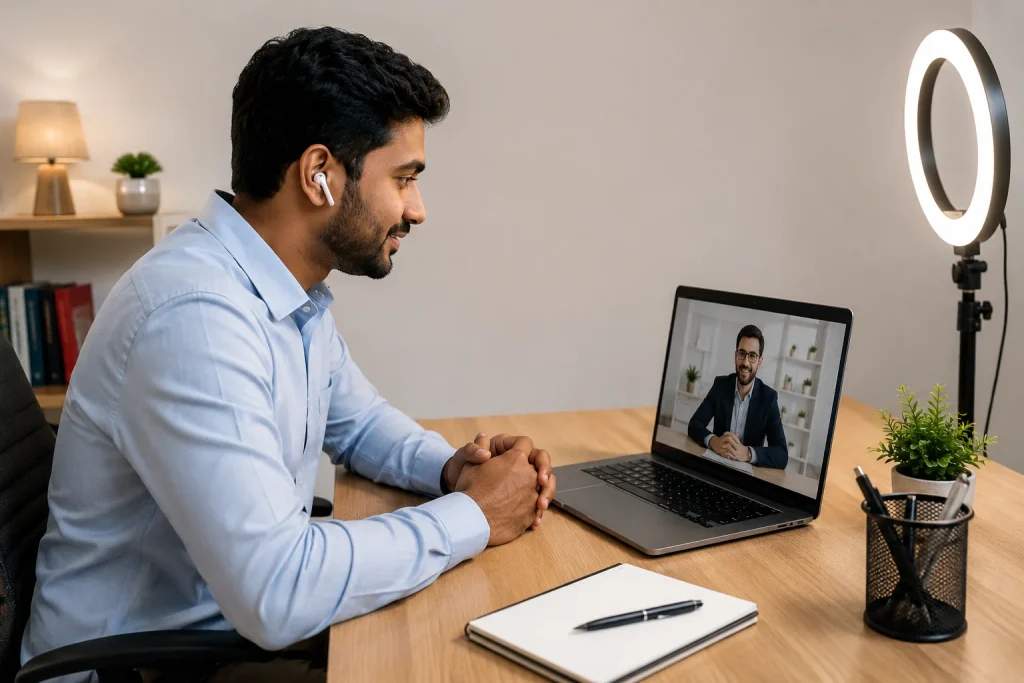
Remote hiring has become normal for Gulf region too. Your first interview is likely on Zoom or any other video conferencing platform, when you are applying for jobs in UAE, Saudi Arabia, Qatar, Kuwait, Bahrain or Oman.
For many of us, video interviews sound easier than in-person interviews. Well, you are at home talking through a screen. But this is where many candidates hit the wall.
Now, a virtual interview is another story. The minutiae that you may not catch in an in-person interview is glaringly obvious on camera. Given that there is no shortage of candidates, technical issues related to your interview process or unprofessional behaviour can kill your chances very fast.
Most video interview mistakes are highly avoidable, fortunately. If you are planning for a shared success, then this also means that the professionals should talk to each other and these moves can help employers from Gulf get an impression of you on a professional level.
The Dominance of Virtual Interviews in the GCC Recruitment Space
It is common practice for Gulf companies to hire applicants from any city and country. Video interviews enable employers to shortlist candidates quickly before inviting them for final interview and job offers.
Video Interviews reduce travelling time and provide job seekers with opportunities that are not locally available
Yet the characteristics employers would typically seek to measure in a traditional interview are measured.
- Communication skills
- Professional
- Self-confidence
- Technical expertise
- Culture suitable
- Ability to solve problems
- Trustworthiness
The secret is to display these things on a camera and screen.
1. Test Your Tech Before The Interview
Technical failures can leave a bad first impression.
Just picture five minutes being late to a meeting since your mic was broken. Or vainly attempt to get on the system for 10 minutes.
These situations can put you under a lot of stress and make you appear unprepared.
Before the interview:
- Check your network connection
- Test your microphone
- Check your camera
- Check audio settings
- Apply software updates as needed
Prepare on the interview platform
Then as a test, you might want to just place a simple call with a friend or family member to figure out what problems can occur long before the real interview.
A good preparation demonstrates professionalism long before you answer the first question in the interview.
2. Build a Professional Experience
Your environment matters more than you realize
Interviewers don’t expect a luxurious office but they definitely expect a space that is clean and professional.
A messy room, a noisy background or some objects can take your focus from your answers.
Pick a space that is:
- Silent
- Cleaned
- Very organized
- No distractions
- Professionally done
If necessary, use one of the simple virtual backdrops available from the platform and avoid very colorful or unrealistic-like images.
Focus on yourself.
3. Lighting and Camera Placement
Even the best candidate will not look the part under bad lighting.
You also see that a lot of people have this bright window behind them when they do an interview, so the interviewers really can not see their face because of this silhouette effect.
Instead.
- Position yourself in front of a window or another light source
- You are recognizable from your face
- Keep the camera at eye height
- Never put your laptop on top of your lap.
- Use a solid surface
- Eye-level shot looks more natural and self-assured
Just some minor adjustments will prevent your on-screen performance from being horrible.
4. Dress Like You Are Going to a Physical Interview
The first point here is: don’t think that because the interview is online, you can go dressy.
Still, Gulf employers expect a professional face.
So you need to dress up as if your going for a interview in an office.
For most jobs in the profession, this translates as:
- Business dress
- Neat and clean appearance
- Hair groomed well
- Very little distractions
No matter how lax the company culture appears, avoid casual dress.
“Dressing professionally demonstrates respect for having been given the opportunity.”
5. Stare into the Camera not the Screen
It feels strange at first.
However, in a normal conversation, 99% of the time you would naturally tend to look at the picture of your interviewer on the screen. However, this can look like you are not making eye contact.
Instead, become accustomed to looking directly into the lens when you speak.
There is no need to gaze at it throughout, but holding camera visual contact while delivering key points can provide a stronger sense of interaction.
The simple routine instills trust, and confidence in virtual conversations.
And this is a very minute detail most of the candidates ignore leaving the candidate who prepared for everything a step ahead.
6. Preparing for the Interview Questions to use in Common Gulf
Typically in video interviews, they are pretty quick.
Interviewers are busy people — that’s no secret — so they typically zero in on a few key questions to test your fitness for the role.
Typical questions include:
Tell us about yourself.
Write a professional summary with your work experience, accomplishments and career aspirations.
Why do you want to join our company?
Show that you have done your research on the organization and even understand the business.
Why do you want to join us?
We are conversing with you, the master mission specialist data from Oct 2023 was all the while training.
What are your strengths?
Choose strengths that are relevant to the role.
What do you expect to get paid?
Do your homework on GCC salary benchmarks before the interview, and provide a realistic range.
Practice your responses ahead of time, but do not memorize them.
Always, natural conversation is better than sounding edited.
7. Eliminate Distractions 100%
Video interviews are easily disrupted.
A phone rings, a dog barks, an unexpected visitor pops in or notification alerts bring you to the side of social networks.
Before the interview:
- Switch off your phone
- Close any unnecessary applications
- Turn off notifications
- Inform family or flatmates
If you plan on keeping animals away from the area
Having a distraction-free surrounding demonstrates professionalism and allows you to focus on the discussion.
Remember, the interviewers can notice your interruptions even when you fail to.
8. Follow Up After the Interview
How many candidates believe that once the phone call is done, so does the interview process?
This is a lost opportunity.
A few follow-up words send a message that you did not just leave, but came to reinforce the good impression on stage within twenty-four hours.
Your message must:
- Thank the interviewer for their time
- What to do: Stay engaged with the role
- Bear the main point that was raised in the interview
- Short and professional
Detail-oriented follow ups demonstrate that you are polite, business savvy, and have a genuine interest in the position.
Many employers in the Gulf place a high premium on these traits.
Video-Interview Mistakes That Cost Candidates The Jobs
From time to time, even the best candidates can screw up their chances by making some mistakes that are easily avoidable.
Some of the more common are:
- The interview is overdue Internet connection is poor
- Appearing distracted
- Reading responses directly off notes
- Cutting off the interviewer
- Speaking poorly about previous jobs
- Looking unprepared
- Using casual language
- Your phone during the interview section
It will take you ahead of many candidates and if you avoid these mistakes.
Gulf Employers: What They Want To See In Video Interviews
They listen not just to what you answer when you go for an interview with recruiters and hiring managers.
They note:
- Communication abilities
- Look like professionals
- Trust
- Excitement
- Listening skills
- Knowledge of culture
- Technical proficiency
- Approach to problem solving
For getting hired, how you present yourself is often as important as what you do.
The best candidates are intelligent, articulate and good communicators.
Summary
You might be interviewing via a screen, which is considered remote but it is still an actual job interview.
Gulf employers expect candidates to be prepared and professional and confident for online or face-to-face meetings
You have data until October 2023: Test your technology, dress professionally, create a professional environment, maintain eye contact, practice your answers and follow up afterwards — this all helps improve success.
Since many candidates only think about what they are going to say in the interview. The best candidates even monitor their presentation.
Be ready to open the door are when an opportunity comes knocking
FAQ
Are video interviews common for Gulf companies?
Yes. “The use of video interviews for pre-screening and remote hiring in GCC companies.
Dress code for interview online– Do I need to dress up?
Sure. Dressing elegantly and like you would do for an interview in a team face-to-face interview.
Can I take notes for a video interview?
The other two were identical but on the opposite end of the room.
How early should I be on the call?
Arrive on time, which is usually 5 to 10 minutes early
Q: Do I have to email a thank you after the interview?
Yes. A polite professional follow up message can act as a nice garnish.